
Be honest — somewhere in reading that title, you probably felt the urge to yawn. Or maybe you saw someone yawn earlier and immediately did it yourself. Yawning spreads like nothing else. But why?
It turns out almost everything most people believe about yawning is wrong — and the real explanation is far more interesting. Like why your stomach growls when you’re hungry, it’s one of those everyday things your body does on autopilot — with a reason most people never learn.
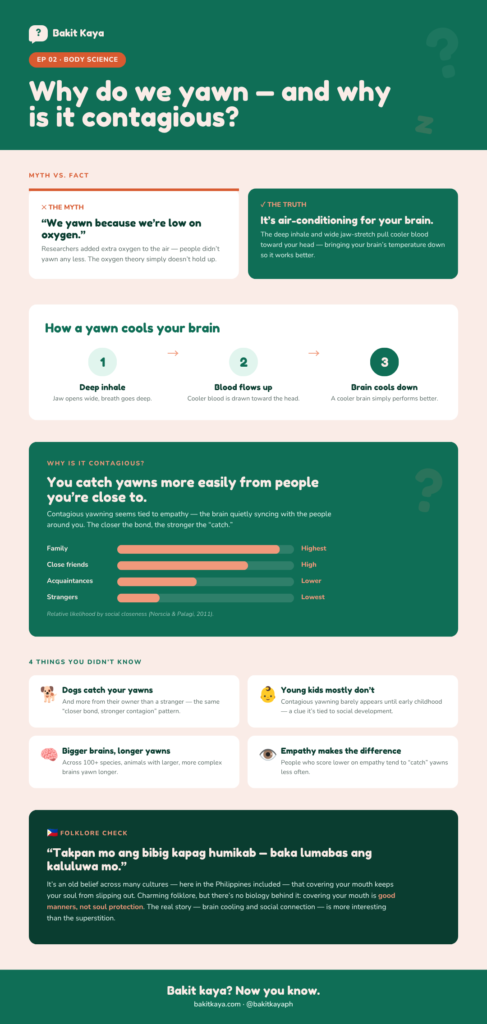
The myth: “we yawn because we need oxygen”
For a long time, the popular explanation was that yawning floods the brain with oxygen — that when you’re low on it, a big deep breath fixes the problem.
It’s a tidy theory. It’s also wrong. Researchers tested it directly: when people breathed air with extra oxygen, they didn’t yawn any less. And breathing air with more carbon dioxide didn’t make them yawn more. If yawning were really about oxygen, those changes should have mattered. They didn’t.
So if it’s not about oxygen — what is it about?
The leading theory: yawning cools your brain
The strongest current explanation is that a yawn works like air-conditioning for your brain.
When you yawn, the deep inhale and the wide stretch of your jaw increase blood flow and pull cooler blood toward your head — helping bring your brain’s temperature down. And that matters, because a brain that runs too warm doesn’t perform as well.
This fits what you already notice in real life: you yawn most when you’re tired, bored, or just waking up — exactly the moments when your brain temperature tends to creep up. The yawn is your body’s built-in cooling system kicking in.
The real mystery: why is it contagious?
Here’s the part scientists are still working out. When you see someone yawn — or even just read or think about yawning — there’s a strong chance you’ll yawn too. This is called contagious yawning, and the leading explanation links it to empathy: our ability to sense and mirror what other people are feeling.
The evidence is intriguing.
Studies have found that people are more likely to “catch” a yawn from someone close to them — family or close friends — than from a stranger, and brain-imaging work points to regions involved in social bonding. It’s worth being honest, though: scientists still debate this.
Some researchers argue the empathy link isn’t fully settled, and that things like how much attention you pay to the other person could also play a role.
Either way, contagious yawning seems to be tied, at least in part, to how socially connected we are — your brain quietly syncing up with the people around you, without you ever deciding to.
A few things about yawning you probably didn’t know
Once you start looking, yawning gets stranger and more fascinating:
- Dogs can catch your yawns — and they catch yours more than a stranger’s. Contagious yawning isn’t just a human thing. It’s been documented in chimps, baboons, and dogs, and research shows dogs are more likely to yawn in response to their owner’s yawn than a stranger’s — the same “closer bond, stronger contagion” pattern seen in people.
- Young children mostly don’t do it. Contagious yawning barely shows up in human behavior until around early childhood, which is part of why scientists link it to social development rather than a simple reflex.
- People who score high on psychopathic traits tend to catch yawns less. Studies have found that individuals scoring higher on traits like callousness and manipulation are less susceptible to contagious yawning — another clue that “catching” a yawn is tied to social connection.
- Bigger, more complex brains yawn longer. In studies across more than 100 mammal and bird species, even after accounting for body size, animals with larger and more complex brains tend to have longer yawns — which fits neatly with the brain-cooling idea.
There’s also a newer theory worth knowing: some researchers think contagious yawning evolved to keep a group alert and in sync — a kind of shared “stay sharp” signal that may even improve how well people notice threats around them.
A quick myth check
Across many cultures — including here in the Philippines — there are old beliefs about yawning, like covering your mouth so your “soul” (or good luck, or a spirit) doesn’t slip out. It’s charming folklore, but there’s no biology behind it.
Covering your mouth when you yawn is good manners, not soul protection. The real story — brain cooling and social connection — is honestly more interesting than the superstition.
So the next time you catch a yawn…
It’s not because you’re low on oxygen. It’s your brain cooling itself down — and, when it spreads, a small everyday sign of just how wired we are to connect with each other.
So, did you catch a yawn while reading this? Bakit kaya? Now you know.
References
- Gallup, A. C., & Gallup, G. G. (2007). Yawning as a brain cooling mechanism: Nasal breathing and forehead cooling diminish the incidence of contagious yawning. Evolutionary Psychology, 5(1). https://journals.sagepub.com/doi/10.1177/147470490700500109
- Princeton University. (2011). More than a sign of sleepiness, yawning may cool the brain. https://www.princeton.edu/news/2011/09/19/more-sign-sleepiness-yawning-may-cool-brain
- Gallup, A. C. (2012). The thermoregulatory theory of yawning: What we know from over 5 years of research. Frontiers in Neuroscience, 6, 188. https://www.frontiersin.org/articles/10.3389/fnins.2012.00188/full
- Norscia, I., & Palagi, E. (2011). Yawn contagion and empathy in Homo sapiens. PLoS ONE, 6(12), e28472. https://journals.plos.org/plosone/article?id=10.1371/journal.pone.0028472
- Live Science. (2025). Why is yawning contagious? https://www.livescience.com/human-behavior/why-is-yawning-contagious
- Science (AAAS). Why yawns are contagious — in all kinds of animals. https://www.science.org/content/article/why-yawns-are-contagious-all-kinds-animals
Frequently asked questions
Do we yawn because we need oxygen?
No — that’s a long-standing myth. Studies showed that giving people extra oxygen didn’t reduce yawning. The leading explanation is that yawning helps cool the brain.
Why is yawning contagious?
Seeing, hearing, or even reading about a yawn can trigger one. Scientists link this partly to social connection — you’re more likely to catch a yawn from someone close to you — though the exact mechanism is still debated.
Why do I yawn when I’m not even tired?
Yawning is tied to brain temperature, not just sleepiness. Boredom, stress, or transitions between activities can all prompt a yawn as your brain regulates itself.
Can you catch a yawn from a dog — or a dog from you?
Yes. Contagious yawning has been seen across species, and research shows dogs are more likely to yawn in response to their owner’s yawn than a stranger’s.
Is contagious yawning a sign of empathy?
It may be connected, but it’s not a reliable test. Some research links it to social bonding, while other scientists argue attention and other factors play a role too.