
You know the feeling. You’re sitting in a quiet classroom, everyone’s heads down, and then — GRRRRRR. Every head turns toward you. You smile, embarrassed, and think, “I’m just hungry.”
But that growl isn’t simply the sound of an empty stomach. There’s an actual, surprisingly clever process happening inside you — and it has a name.
It’s called borborygmi
That rumbling sound has a real medical term: borborygmi. And here’s the part most people get wrong: it isn’t random, and it isn’t just “because you’re empty.” Your stomach growls in a specific, organized way — and it tends to get louder when you’re hungry, not when you’re full. The reason why is the interesting bit.
First, where the sound actually comes from
When you eat, food moves through your digestive system through a process called peristalsis — wave-like muscle contractions that squeeze food, liquid, and gas downward through your gut.
Here’s the key: those contractions don’t stop when your stomach is empty. They keep going. The difference is that when there’s food and liquid in there, it muffles the sound. When your stomach and intestines are empty, there’s nothing to soften the noise — so the same squeezing you’d never normally hear suddenly becomes loud and clear.
But “there’s nothing in there to muffle it” is only half the story. The louder, more frequent growling when you’re hungry points to something more active going on.
The part nobody talks about: your gut has a cleaning crew
About every 1.5 to 2 hours, when no food is coming in, your body releases a hormone called motilin.
Motilin triggers something called the migrating motor complex — think of it as a cleaning wave that sweeps through your stomach and small intestine. Its job is to clear out leftover food particles, bacteria, and gas, even when you haven’t eaten anything.
It’s basically your body running an automatic housekeeping cycle, whether you’re in class, at your desk, or asleep.
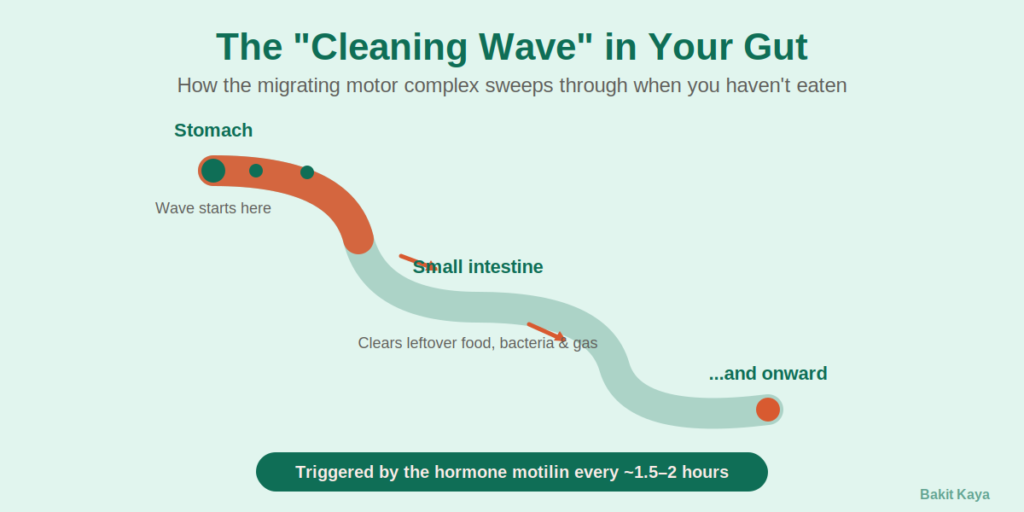
The longer you go without eating, the stronger and more frequent these contractions become. And because there’s no food in there to absorb the sound, you hear every bit of it.
So the next time your stomach growls…
It’s not just begging for food. That sound is your digestive system doing real maintenance work — a built-in cleaning crew that runs on schedule, with or without your permission. (Here’s another: why we yawn — and why it’s so contagious.)
So when your stomach rumbles in the middle of a quiet class, now you know: it’s not just hunger. It’s your body, quietly doing its job.
References
- Colorado State University. The Migrating Motor Complex (Pathophysiology of the Digestive System). http://www.vivo.colostate.edu/hbooks/pathphys/digestion/stomach/mmcomplex.html
- Deloose, E., Janssen, P., Depoortere, I., & Tack, J. (2012). The migrating motor complex: control mechanisms and its role in health and disease. Nature Reviews Gastroenterology & Hepatology, 9(5), 271–285. https://pubmed.ncbi.nlm.nih.gov/22450306/
Frequently asked questions
Does a growling stomach always mean I’m hungry?
No. Your stomach and intestines make these sounds as they move food, liquid, and gas along — even when you’re not hungry. They’re just louder and easier to hear when your stomach is empty.
What is the growling sound actually called?
The medical term is borborygmi. It describes the rumbling noises made by your digestive system as its muscles contract.
Why does my stomach growl louder when I haven’t eaten?
When your stomach is empty, there’s no food or liquid to muffle the sound. On top of that, an empty gut triggers stronger “cleaning wave” contractions, which makes the noise more noticeable.
Can I stop my stomach from growling?
Eating or drinking something usually quiets it, since food muffles the sound and pauses the empty-stomach cleaning cycle. But it’s a normal, healthy process — there’s nothing wrong with a growling stomach.